Trude
From Germanic, Gertrud, hypocorism: female friend.
This city produces the light and dark spectrum of SiPMs for dedicated calibration runs. This is achieved by selecting regions in the SiPM waveforms where LED pulses are expected and regions which end 2 microseconds before (this value is hardcoded to avoid the overlap with light pulses), respectively and integrating the content within each region. The regions before LED pulses should only contain electronics noise and dark counts giving the zero external light approximation whereas those in time with the pulses will contain one or more detected photoelectrons. The waveform integrals are split into two groups: those with expected photoelectrons (light) and those without expected photoelectrons (dark). Each group produces a different spectrum.
Input
/Run/events: list of theevt_numberand the correspondenttimestamp.
/Run/runInfo: stores therun_number.
/RD/sipmrwf: stores the raw waveform itself. It indicates the number of \(ADCs\) per time bin for each event and SiPM.
Output
/HIST/sipm_dark: histogram values of the dark spectrum./HIST/sipm_dark_bins: bin values of the dark spectrum./HIST/sipm_spe: histogram values of the light spectrum./HIST/sipm_spe_bins: bin values of the light spectrum.
Config
Besides the Common arguments to every city, Trude has the following arguments:
Parameter |
Type |
Description |
|---|---|---|
|
|
Lower/upper limit of the number of \(ADCs\) of the waveform to be considered for the spectrum. |
|
|
Width of the bins for the spectrum in \(\mu s\). |
|
|
Two options of subtracting the baseline: |
|
|
Number of integrals to be performed in the waveform’s time window. Typically this value is selected depending on the number of LED pulses in the waveform. E.g. if the waveform has 5 pulses, the number of integrals will be 5. |
|
|
Bin in \(\mu s\) where the first integral of the set of |
|
|
Number of bins to be considered for the integral starting at |
|
|
Period between integrals. This parameter won’t be considered when |
Workflow
Trude performs the following operations to obtain the spectra:
Selection of integration limits
Given the config parameters, the first step in this city would be to select the dark and light bins to compute the dark and light spectra.
The light bins will be centered in the light pulse(s) and the dark bins are chosen as an interval of integral_width bins which ends 2 \(\mu s\) before the light pulse begins, as shown here:
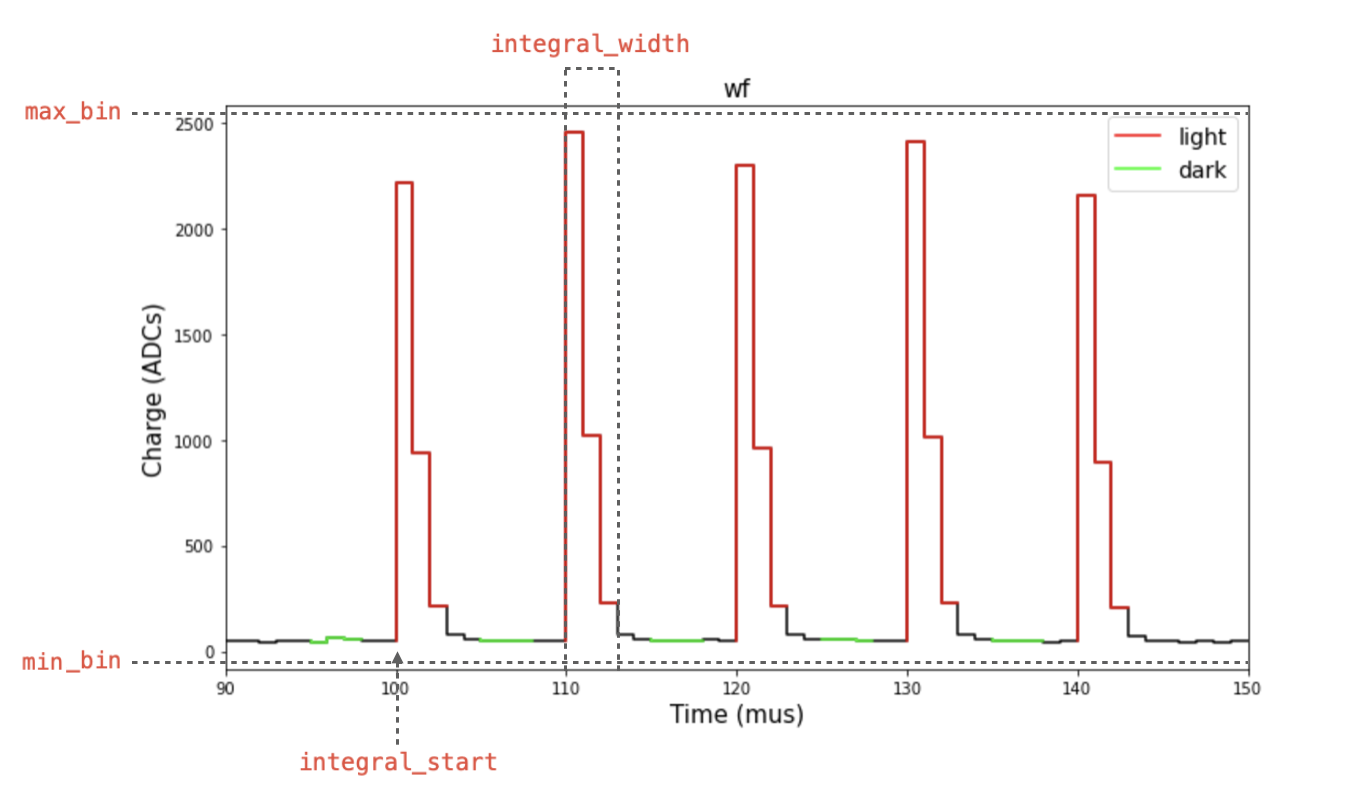
Typically, the limits are set to min_bin = -49.5 and max_bin = 4000.5 ADCs since it is the range of the waveform window.
SiPM waveforms baseline subtraction
Same procedure as described in Baseline subtraction of SiPM waveforms section of the Irene documentation with the option of using the mean instead of the mode of the waveform for the baseline subtraction.
Spectrum histogram
The last step would be the integration of the dark and light bins in order to obtain the respective spectrum histograms.
For each of the regions it sums all the \(ADCs\) in the intervals and adds an entry to the histogram. It repeats this for each waveform of the same sensor.
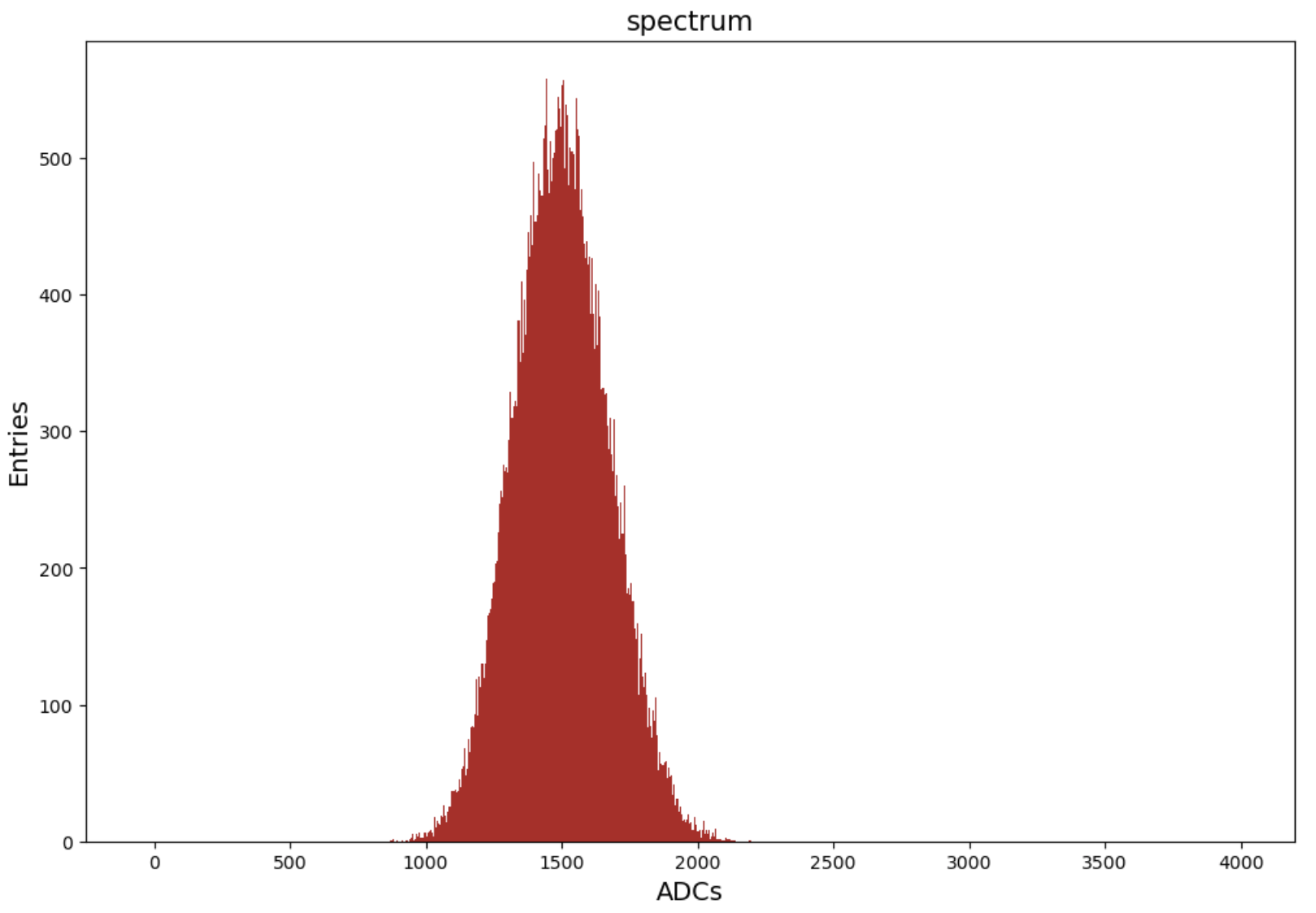
The end result will be a h5 file with /HIST/sipm_dark and /HIST/sipm_spe with a table per time bin and an entry per sensor. In the following plot you will find a light spectrum for a given channel.